Past The Sponsorship
Past The Sponsorship
Past The Sponsorship
The watch that fights the wave
The watch that fights the wave
The watch that fights the wave
The watch that fights the wave
The watch that fights the wave
The deal
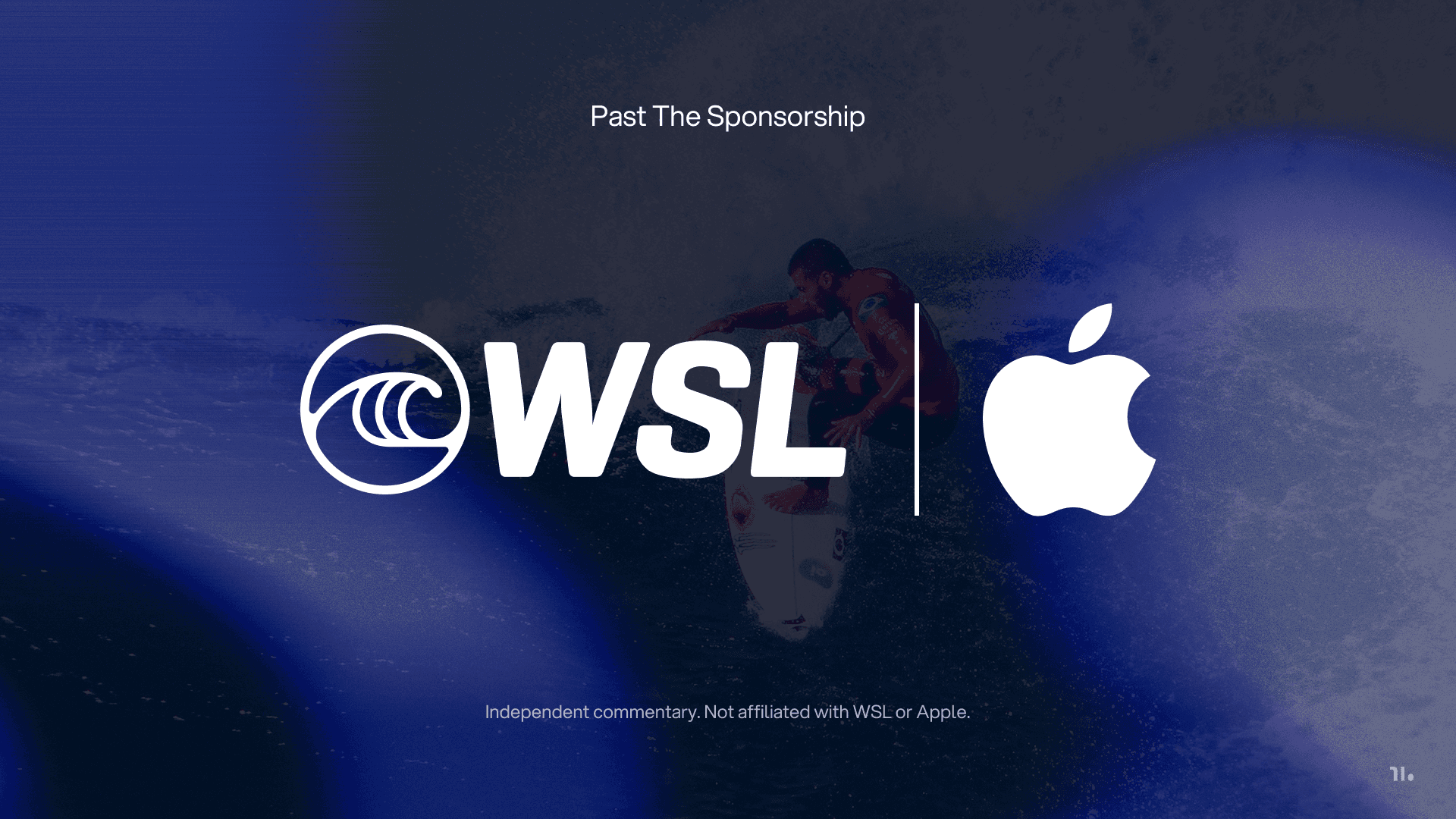
Since 2023, the Apple Watch has been the official wearable of the World Surf League. Every surfer straps one on before a heat. It runs the WSL Surfer app and feeds them their score, wave priority and time left while they're sat out the back. This year it grew again. The watch data now goes into the broadcast too, so fans at home get wave speed, distance paddled and heart rate, live. Apple calls it advancing the sport. Both sides are proud of it. On paper it's a flagship deal, the kind most leagues would love to announce.
So it's worth a proper look. Not because it's a disaster, it isn't. Because it's a smart deal pointed at the wrong place. And the gap between what it says it does and what it actually does is one of the clearest I've seen in a while.
What's working
Let's give it full credit, because there's a real problem being solved here.
Surfing is harder to follow than most sports. The surfers are often way out to sea, and it changes venue to venue, in Saquarema the crowd's right on top of the action, in Tahiti it's a distant lineup you can barely make out. There are big screens on the beach, announcers talking the whole way through, the broadcast in the towers and hospitality, so people can follow it. But it takes work, and it's never quite the same experience twice. The WSL has been chipping away at this for years, and it's a fair thing to want to fix.
For the surfers, this is a genuinely big deal. Live score, who has priority, and how much time is left in the heat, straight to the wrist. That used to lean on beach announcers and flags they couldn't always see or hear from hundreds of metres out, so they were often competing on guesswork. Now they know exactly where they stand and what they need. And it works in conditions that would kill most kit. Credit where it's due, that's a real win for the athletes.
The broadcast data is where it gets thinner. To be fair, speed and distance aren't nonsense numbers, they do feed into how a wave is scored. The problem is showing them to a fan on their own. Surfing isn't scored on whoever went fastest or rode longest. It's how a surfer reads and moves through the wave, and that shifts with the type of wave and the conditions on the day, a big air on a punchy wave can beat a long clean cutback, and the scores can even drift as the swell builds or drops through the day. Drop a speed number on screen with none of that and a newer fan walks away thinking faster and longer means better, which isn't how it works at all. So the real value here is the live scoring. The rest can confuse more than it clears up.
Where it falls short
Here's the thing. The gap they closed is a fan gap. But the story they're telling is an athlete one.
Read the language around this deal and it's all performance. Helping surfers perform at their best. Elevating athlete performance. Tech as part of how they compete. That's the pitch. And it's the one thing the watch does not do.
A watch does not make you surf better. Fins and a board make you surf better. Being in the water makes you surf better. The watch won't tell you your back foot's off-centre, or that you're not using your head and upper body to drive the turn, or that you're late off the bottom. It can count your heart rate and how far you paddled. No surfer cares how far they paddled. They care about the wave.
And you can't learn from a watch anyway. You learn from being in the water and from watching yourself back on video. Not from numbers on your wrist. Tech is never going to give you the thing surfing is actually about, which is the connection with the wave.
Watch the tour and it tells you everything. You rarely see one on a free surf. You don't see the best surfers wearing an Apple Watch down the beach on their day off. It goes on before the heat and comes off after, because it's kit, not a choice. Yes, everyone owns an Apple. That's just default, it's what everyone has, not something anyone believes in. If Apple really owned surf data, these surfers would wear the watch when nobody was watching them compete. They don't. That's the tell.
And that's before the water fights back. Most of the time they've got a long-sleeve wetsuit over the top, so now you're peeling the sleeve back mid-heat to check your wrist. Wet fingers on a touchscreen, which anyone with a smartwatch knows is a losing battle the second your skin's wet. A buzz on the wrist just as you're going for a wave, which is the opposite of the flow the whole sport runs on. And worst case, a hard edge on your arm at the wall of a heavy wave like Teahupo'o, the one place you don't want anything catching. The product is fighting the water it's been put in.
The one honest line I've heard from a surfer is that the watch let them trust what was going on and let go. Fair. But letting go is the oldest instinct in surfing, not something Apple invented. Surfing isn't football with a set pitch that comes down to the players. The ocean is alive, always moving, never the same twice, and every surfer knows that from day one. These aren't beginners. They're pros who've been reading the ocean since before they could walk.
The three audiences
A partnership only works if you serve three groups: your athletes, your fans, and your partner's customers. Each one has a real problem underneath. Line them up and you can see where this deal lands and where it doesn't.
Start with the athletes. For years they were stuck out the back with no clean way to know their score or who had priority, competing half-blind, guessing at what was going on. And underneath that, their whole craft is a conversation with a moving ocean, read in the body, not off a screen. The scoring genuinely fixes the guessing. But the deal is sold as performance, and performance is the one thing a watch can't touch. So what the athletes get is real, and much smaller than the story claims.
Then the fans. Most people who watch surfing already surf, so they read a heat fine, they know what a good wave is and what a surfer's trying to do on it. The people who actually struggle are the newer fans, the ones the sport needs if it wants to grow, who don't surf and can't yet tell a good ride from an average one. That's the real gap. And what pulls anyone to surfing in the first place is the soul of it, the thing they want to belong to. Scoring made visible helps a newcomer follow along. So this is the group the deal really serves. And it's the one the marketing never quite admits it's serving.
And then Apple's customers, which is where it breaks. An Apple buyer wants clean, premium, status tech that says something about them, prestige and polish, being part of something sleek. That's the whole relationship, refinement and control. Now put that next to a surf fan: authenticity, roots, connection to nature, being one with something wild. Those two don't touch anywhere. There's no version of the Apple customer who sees themselves in surfing, and no version of the surf fan who sees themselves in Apple. It doesn't help that Apple isn't the brand you reach for when you want real sport data, that's Garmin, Whoop, Oura, or that Apple isn't exactly known for surviving water. The point isn't the product. It's that the people don't overlap.
And here's the part that makes the mismatch worse. Ten years ago this deal might have worked, because ten years ago Apple still meant something. Under Jobs it stood for different, simple, creative, the brand that broke the rules. That was worth borrowing. But it hasn't moved on. The phones cost more and do roughly what the last one did, the batteries fade on schedule, and plenty of people feel quietly ripped off by the whole cycle. Meanwhile everyone else caught up and some passed it. So yes, everyone still buys Apple, but out of habit, not love. And you can't lend a sport a meaning you've already lost. That's why "but everyone owns an Apple" isn't the win it sounds like. Owning one isn't the same as believing in it.
That's the failure. Not that Apple is a bad brand. That Apple's people and surfing's people share nothing. The whole job of a partner deal is to give the brand's customers a bigger stage to be who they are inside your culture. Apple's customers were never going to find themselves here. You've built a bridge with no one on the other side.
What it's costing them
This is where it stops being an academic point.
Surfing's whole value is its soul. It's one of the last sports still rooted in something real, island culture, deep history, a bond with nature that fans and surfers are proud of. That's the asset. It's the whole reason a brand wants in. Every sponsor circling this sport is really paying to stand near that.
And the one value the culture is built on is freedom from the clock. The oldest joke in surfing is you say you'll be an hour and you're gone four, because there's no watch out there counting your time or your waves. That's not a throwaway. Losing track of time is the point. It's why people surf.
So a flagship deal built on a watch, a thing whose whole job is tracking time and data, sold as the future of the sport, quietly works against the thing that made the sport worth sponsoring. Not in a way you'll see on a chart. Slowly. The fans who'd back a partnership that got them don't hate this one. They just don't see themselves in it, so they scroll past. And a sponsorship fans ignore is the most expensive kind, because you've paid full price for belonging and got utility.
There's a simpler cost too. The best thing this deal does is make surfing easier to follow, and that's a fan win. But they've dressed it up as an athlete story, so the one genuinely good result is the thing the marketing talks about least. They fixed a real problem and then hid it behind a claim that doesn't hold up.
Where it could go
The frustrating bit is how close it is. The gap was real. The instinct to close it was right. The bridge just got built to the wrong place.
There's a better version of this, and it isn't complicated. Own the fan win out loud instead of borrowing an athlete story you can't back up. Close the follow-along gap without asking surfers to wear something they'd never choose, screens, boats, broadcast, whatever fits the water instead of fighting it. And before any of that, ask the one question that got skipped: whose customers can actually find themselves in this culture and be who they are through it? Answer that honestly and you don't end up with Apple. You end up with a brand surf fans would be proud to see standing next to their sport.
That's the whole game. Not a deal that looks good in a press release, a deal fans lean into because it feels like them. One works on paper. The other one people actually live inside. And everything valuable sits in the gap between those two.
Apple built a bridge to utility. It never built one to belonging. And in surfing, belonging was the whole point.
— Jana
The deal
Since 2023, the Apple Watch has been the official wearable of the World Surf League. Every surfer straps one on before a heat. It runs the WSL Surfer app and feeds them their score, wave priority and time left while they're sat out the back. This year it grew again. The watch data now goes into the broadcast too, so fans at home get wave speed, distance paddled and heart rate, live. Apple calls it advancing the sport. Both sides are proud of it. On paper it's a flagship deal, the kind most leagues would love to announce.
So it's worth a proper look. Not because it's a disaster, it isn't. Because it's a smart deal pointed at the wrong place. And the gap between what it says it does and what it actually does is one of the clearest I've seen in a while.
What's working
Let's give it full credit, because there's a real problem being solved here.
Surfing is harder to follow than most sports. The surfers are often way out to sea, and it changes venue to venue, in Saquarema the crowd's right on top of the action, in Tahiti it's a distant lineup you can barely make out. There are big screens on the beach, announcers talking the whole way through, the broadcast in the towers and hospitality, so people can follow it. But it takes work, and it's never quite the same experience twice. The WSL has been chipping away at this for years, and it's a fair thing to want to fix.
For the surfers, this is a genuinely big deal. Live score, who has priority, and how much time is left in the heat, straight to the wrist. That used to lean on beach announcers and flags they couldn't always see or hear from hundreds of metres out, so they were often competing on guesswork. Now they know exactly where they stand and what they need. And it works in conditions that would kill most kit. Credit where it's due, that's a real win for the athletes.
The broadcast data is where it gets thinner. To be fair, speed and distance aren't nonsense numbers, they do feed into how a wave is scored. The problem is showing them to a fan on their own. Surfing isn't scored on whoever went fastest or rode longest. It's how a surfer reads and moves through the wave, and that shifts with the type of wave and the conditions on the day, a big air on a punchy wave can beat a long clean cutback, and the scores can even drift as the swell builds or drops through the day. Drop a speed number on screen with none of that and a newer fan walks away thinking faster and longer means better, which isn't how it works at all. So the real value here is the live scoring. The rest can confuse more than it clears up.
Where it falls short
Here's the thing. The gap they closed is a fan gap. But the story they're telling is an athlete one.
Read the language around this deal and it's all performance. Helping surfers perform at their best. Elevating athlete performance. Tech as part of how they compete. That's the pitch. And it's the one thing the watch does not do.
A watch does not make you surf better. Fins and a board make you surf better. Being in the water makes you surf better. The watch won't tell you your back foot's off-centre, or that you're not using your head and upper body to drive the turn, or that you're late off the bottom. It can count your heart rate and how far you paddled. No surfer cares how far they paddled. They care about the wave.
And you can't learn from a watch anyway. You learn from being in the water and from watching yourself back on video. Not from numbers on your wrist. Tech is never going to give you the thing surfing is actually about, which is the connection with the wave.
Watch the tour and it tells you everything. You rarely see one on a free surf. You don't see the best surfers wearing an Apple Watch down the beach on their day off. It goes on before the heat and comes off after, because it's kit, not a choice. Yes, everyone owns an Apple. That's just default, it's what everyone has, not something anyone believes in. If Apple really owned surf data, these surfers would wear the watch when nobody was watching them compete. They don't. That's the tell.
And that's before the water fights back. Most of the time they've got a long-sleeve wetsuit over the top, so now you're peeling the sleeve back mid-heat to check your wrist. Wet fingers on a touchscreen, which anyone with a smartwatch knows is a losing battle the second your skin's wet. A buzz on the wrist just as you're going for a wave, which is the opposite of the flow the whole sport runs on. And worst case, a hard edge on your arm at the wall of a heavy wave like Teahupo'o, the one place you don't want anything catching. The product is fighting the water it's been put in.
The one honest line I've heard from a surfer is that the watch let them trust what was going on and let go. Fair. But letting go is the oldest instinct in surfing, not something Apple invented. Surfing isn't football with a set pitch that comes down to the players. The ocean is alive, always moving, never the same twice, and every surfer knows that from day one. These aren't beginners. They're pros who've been reading the ocean since before they could walk.
The three audiences
A partnership only works if you serve three groups: your athletes, your fans, and your partner's customers. Each one has a real problem underneath. Line them up and you can see where this deal lands and where it doesn't.
Start with the athletes. For years they were stuck out the back with no clean way to know their score or who had priority, competing half-blind, guessing at what was going on. And underneath that, their whole craft is a conversation with a moving ocean, read in the body, not off a screen. The scoring genuinely fixes the guessing. But the deal is sold as performance, and performance is the one thing a watch can't touch. So what the athletes get is real, and much smaller than the story claims.
Then the fans. Most people who watch surfing already surf, so they read a heat fine, they know what a good wave is and what a surfer's trying to do on it. The people who actually struggle are the newer fans, the ones the sport needs if it wants to grow, who don't surf and can't yet tell a good ride from an average one. That's the real gap. And what pulls anyone to surfing in the first place is the soul of it, the thing they want to belong to. Scoring made visible helps a newcomer follow along. So this is the group the deal really serves. And it's the one the marketing never quite admits it's serving.
And then Apple's customers, which is where it breaks. An Apple buyer wants clean, premium, status tech that says something about them, prestige and polish, being part of something sleek. That's the whole relationship, refinement and control. Now put that next to a surf fan: authenticity, roots, connection to nature, being one with something wild. Those two don't touch anywhere. There's no version of the Apple customer who sees themselves in surfing, and no version of the surf fan who sees themselves in Apple. It doesn't help that Apple isn't the brand you reach for when you want real sport data, that's Garmin, Whoop, Oura, or that Apple isn't exactly known for surviving water. The point isn't the product. It's that the people don't overlap.
And here's the part that makes the mismatch worse. Ten years ago this deal might have worked, because ten years ago Apple still meant something. Under Jobs it stood for different, simple, creative, the brand that broke the rules. That was worth borrowing. But it hasn't moved on. The phones cost more and do roughly what the last one did, the batteries fade on schedule, and plenty of people feel quietly ripped off by the whole cycle. Meanwhile everyone else caught up and some passed it. So yes, everyone still buys Apple, but out of habit, not love. And you can't lend a sport a meaning you've already lost. That's why "but everyone owns an Apple" isn't the win it sounds like. Owning one isn't the same as believing in it.
That's the failure. Not that Apple is a bad brand. That Apple's people and surfing's people share nothing. The whole job of a partner deal is to give the brand's customers a bigger stage to be who they are inside your culture. Apple's customers were never going to find themselves here. You've built a bridge with no one on the other side.
What it's costing them
This is where it stops being an academic point.
Surfing's whole value is its soul. It's one of the last sports still rooted in something real, island culture, deep history, a bond with nature that fans and surfers are proud of. That's the asset. It's the whole reason a brand wants in. Every sponsor circling this sport is really paying to stand near that.
And the one value the culture is built on is freedom from the clock. The oldest joke in surfing is you say you'll be an hour and you're gone four, because there's no watch out there counting your time or your waves. That's not a throwaway. Losing track of time is the point. It's why people surf.
So a flagship deal built on a watch, a thing whose whole job is tracking time and data, sold as the future of the sport, quietly works against the thing that made the sport worth sponsoring. Not in a way you'll see on a chart. Slowly. The fans who'd back a partnership that got them don't hate this one. They just don't see themselves in it, so they scroll past. And a sponsorship fans ignore is the most expensive kind, because you've paid full price for belonging and got utility.
There's a simpler cost too. The best thing this deal does is make surfing easier to follow, and that's a fan win. But they've dressed it up as an athlete story, so the one genuinely good result is the thing the marketing talks about least. They fixed a real problem and then hid it behind a claim that doesn't hold up.
Where it could go
The frustrating bit is how close it is. The gap was real. The instinct to close it was right. The bridge just got built to the wrong place.
There's a better version of this, and it isn't complicated. Own the fan win out loud instead of borrowing an athlete story you can't back up. Close the follow-along gap without asking surfers to wear something they'd never choose, screens, boats, broadcast, whatever fits the water instead of fighting it. And before any of that, ask the one question that got skipped: whose customers can actually find themselves in this culture and be who they are through it? Answer that honestly and you don't end up with Apple. You end up with a brand surf fans would be proud to see standing next to their sport.
That's the whole game. Not a deal that looks good in a press release, a deal fans lean into because it feels like them. One works on paper. The other one people actually live inside. And everything valuable sits in the gap between those two.
Apple built a bridge to utility. It never built one to belonging. And in surfing, belonging was the whole point.
— Jana

Creative strategist and advisor specialising in commercial partnerships and narrative strategy
Creative strategist and advisor specialising in commercial partnerships and narrative strategy
Creative strategist and advisor specialising in commercial partnerships and narrative strategy
Creative strategist and advisor specialising in commercial partnerships and narrative strategy

©2026 Jana Ballieul.
©2026 Jana Ballieul.
©2026 Jana Ballieul.
All Rights Reserved. Designed in Figma. Built in Framer.
All Rights Reserved. Designed in Figma. Built in Framer.
All Rights Reserved. Designed in Figma. Built in Framer.